Proposed ‘Mulloway Improvement Program’ for Victoria
Summary
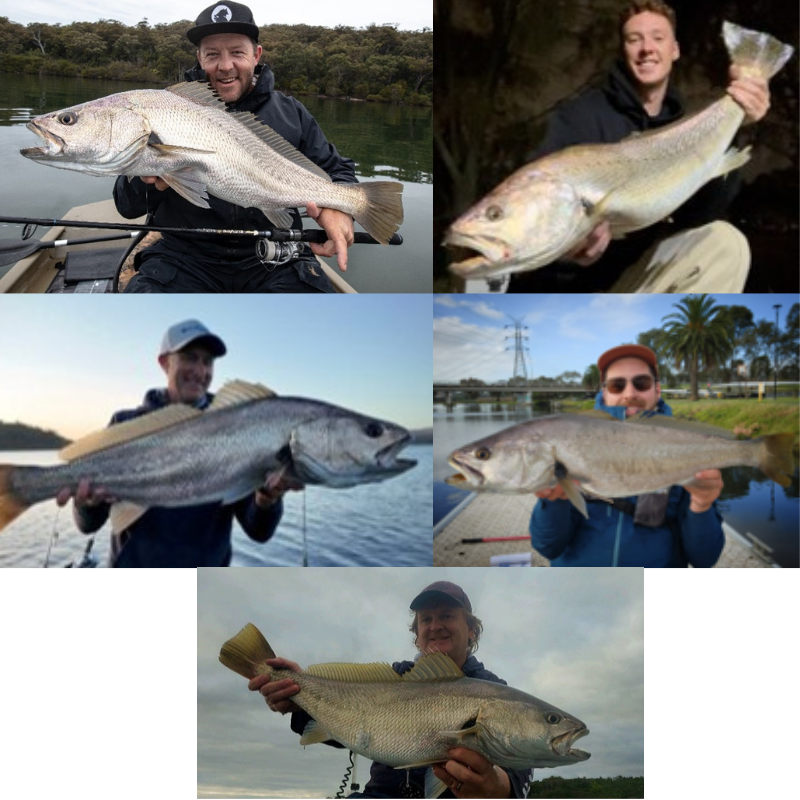
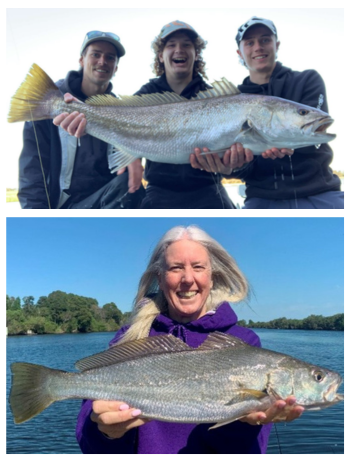
Mulloway are a premier recreational fish species in Victoria, typically averaging 3-10kg each, often over 1 metre in length and sometimes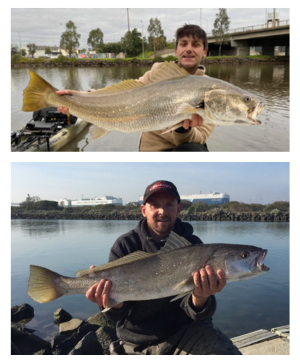 up to 30kg in weight.
In recent years, recreational fishers have raised concerns regarding Mulloway, including:
- Declines in numbers in some estuaries since the 1990s and 2000s
- High angler recaptures of tagged mulloway
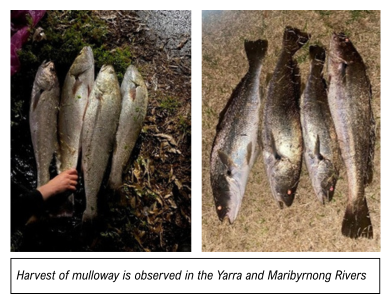
- High harvest observed in some urban Melbourne estuaries
- Current recreational fishing regulations for the species seen as outdated, particularly the 5 fish per person day bag limit, being seen as beyond a reasonable day’s harvest for large fish.
The VFA, in partnership with recreational fishers, have reviewed the best available scientific information on mulloway and neighbouring jurisdictions management (which we share mulloway stocks with), and is proposing a Mulloway Improvement Program, consisting of short-, medium- and long-term fisheries management actions to improve Mulloway fishing in Victoria:
Short Term - Revise recreational fishing regulations for mulloway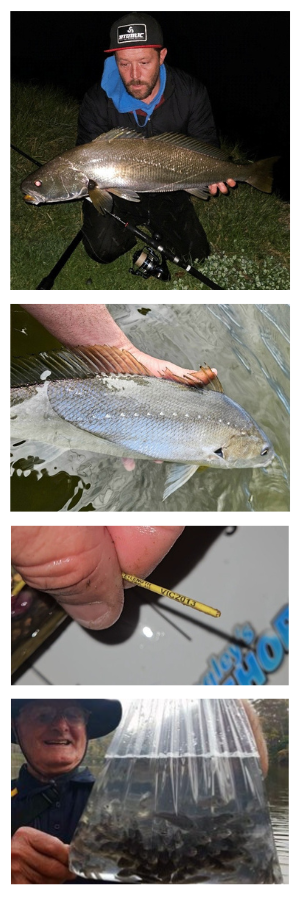
- Change the bag limit from 5 mulloway per person per day to 2 mulloway per person per day, that better reflects a ‘fair days take’, shares the resource and aligns with other large bodied marine species such as kingfish, tuna and gummy shark, as well as the South Australian bag limit for Mulloway.
Increase the minimum size limit from 60cm to 70cm to give mulloway approximately 10 months extra protection from harvest, allow more fish to reach sexual maturity/spawning size, and align with the minimum size limit with New South Wales for consistency.
Medium Term – Invest in our understanding of mulloway
- Restart an angler tagging program for mulloway in Victoria to continue understanding growth, movement and connectivity of the species, complementing tagging programs in South Australia and New South Wales.
- Expand on a project to scientifically track mulloway around Melbourne Rivers (led by Arthur Rylah Institute/Melbourne Water) to better understand mulloway spawning, movement and habitat use with respect to flows.
Long Term – Captively breed and stock mulloway
- Trial the experimental release of mulloway in Victorian estuaries to improve populations, building on Victoria’s long history of successful fish stocking.
Implementing the proposed Mulloway Improvement Program is expected to better reflect recreational fisher views of a reasonable day’s harvest, reduce local depletion of mulloway in rivers and estuaries, and improve the mulloway fishery quality through growth, breeding and stocking.
Recreational fishers are invited to have their say on the proposal to implement the Mulloway Improvement Program by emailing taylor.hunt@vfa.vic.gov.au during the 30-day public consultation period of commencing on 15 July until 15 August 2026.
In particular, we're seeking recreational fisher feedback on:
- Do you support implementing this proposal, as compared with no change to current management arrangements?
- Do you have any further suggested refinements to this proposal?
Download a one-page summary of the proposed Mulloway Improvement Program here.
If you have questions, would like further information, or a short information briefing to your fishing organisation, feel free to contact Taylor Hunt, Manager of Recreational Fisheries on taylor.hunt@vfa.vic.gov.au or 0418 478 028.
Background
Mulloway are a highly sought after and valued recreational fish species in Victoria. The species typically averages 3-10kg each, often over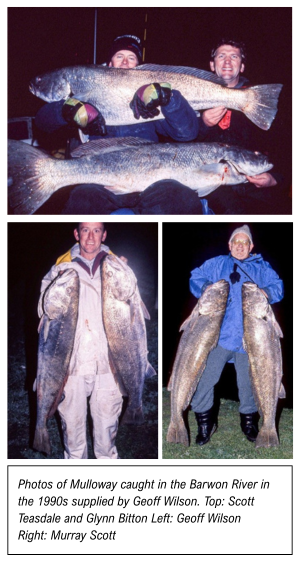 1 metre in length and sometimes up to 30kg in weight.
In recent years, recreational fishers have raised concerns regarding Mulloway including:
- Declines in numbers in some estuaries since the 1990’s and 2000’s including Barwon River, Hopkins River, Maribyrnong River, Yarra River and Westernport.
- High angler recaptures of tagged mulloway with the same mulloway being caught two, three and four times.
- High harvest observed in some urban Melbourne rivers such as the Yarra and Maribyrnong Rivers.
- Current recreational fishing regulations for the species seen as outdated, particularly the 5 fish per person day bag limit, being seen as beyond a reasonable day’s harvest for large fish.
The current Victorian bag limit for mulloway of five fish per person per day and size limit of 60cm were introduced in 2009 (17 years ago).
In 2024 the VFA agreed to consider changes to the management of Mulloway to potentially benefit the fishery.
Science and Management Considerations
In considering management changes which hope to benefit the mulloway population and fishing community, it’s important to review and reflect on our scientific understanding and management context for mulloway.
As such, the VFA and recreational fishers (including using Recreational Fishing Licence funds) have worked collaboratively with research scientists to improve our scientific understanding of mulloway biology, ecology and population dynamics.
Key scientific points include:
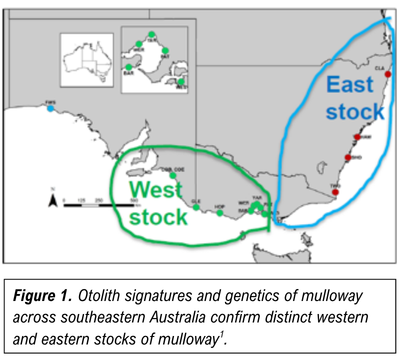
- Victoria has two distinct genetic stocks of mulloway1:
- ‘Western’ stock (Westernport, Patterson River, Yarra River, Werribee River, Barwon River, Hopkins, Glenelg) extending to the Coorong in South Australia
- ‘Eastern’ stock (Mallacoota and Gippsland Lakes) extending up NSW coast into Queensland
- The stocks are scientifically assessed as ‘Sustainable’ (Western stock) and ‘Recovering’ (Eastern stock)2.
- Mulloway are episodic spawners (they only breed sporadically around environmental triggers, not every year), and successful recruitment is believed to occur around high flow events, which can be infrequent1,4,5.
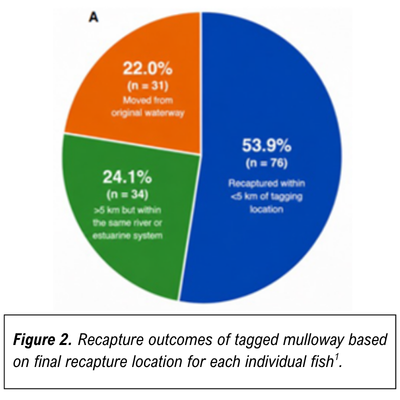
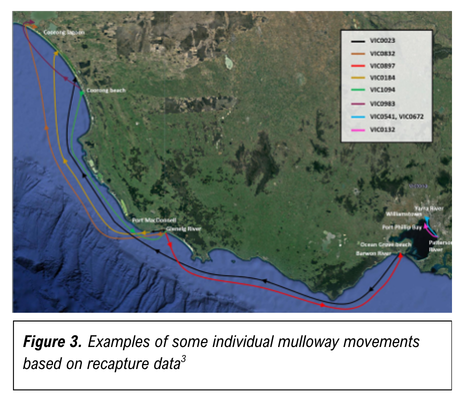
- Recaptures of angler tagged mulloway are high – suggesting high vulnerability and limited home ranges1,3.
- Whilst a small number of mulloway can move large distances between systems (up to 700km)3, mulloway typically show strong evidence of local estuarine residency and restricted home ranges with over 70% recaptured within the same system1.
- Given the species has episodic spawning, irregular recruitment, and local estuarine residency, mulloway are regarded as being vulnerable to localised depletion1.
- Size at which 50% of mulloway are sexually mature is 78-85cm for western stock4 and 51-68cm for eastern stock5 (note, some mulloway reach sexual maturity at smaller and larger sizes).
Given the mulloway stocks and fisheries span across several Australian jurisdictions, it’s also important to understand the current management arrangements in each jurisdiction (Table 1).
Table 1. Current management arrangements for mulloway across jurisdictions including harvest and estimated percentage of stock harvest.
State | Stock | Size limit | Bag limit | Harvest (tonnes) | Est % stock harvest | Tagging | Stocking |
VIC (current) | Both | 60 cm | 5 | Comm: 0.05t | ~3-6% | Not yet | Not yet |
NSW | East | 70 cm | 1 | Comm: 79t (2021-22) | ~86% | Yes | Yes |
QLD | East | 75 cm | 2 | Comm: 7.5t (2021-22) | ~11% | Yes | No |
SA | West | 82 cm | 2 | Comm: 56t (2021-22) | ~94% | Yes | No |
SA Coorong | West | 46-82 cm | 10 |
Victoria’s estimated harvest percentage of the western and eastern mulloway stocks is small indicating that changes in Victoria will unlikely affect stock sustainability, however there are opportunities for improved fisheries management and outcomes, through alignment and collaboration regarding bag and size limits, tagging and stocking.
Key scientific references:
- Brown, L. Whiterod, N.S., Rizzari, J., Barnes, T.C., Morrongiello, J.R., Lieschke, J., and Miller, A.D. (Submitted June 2026) Complex patterns of biological connectivity highlight risks of local depletion in an Australian fishery Estuaries, Coastal and Shelf Science
- Mulloway (2023) Status of Australian Fish Stocks Report. Fisheries Research Development Corporation
- Tracking Mulloway Movements – Recreational Fishing Licence Large Grant Project
- Ferguson, G.J., Ward, T.M., Ivey, A. and Barnes, T. (2014) Life history of Argyrosomus japonicus, a large sciaenid at the southern part of its global distribution: implications for fisheries management, Fisheries Research, 151: 148–157.
- Silberschneider, V., Gray, C.A. and Stewart, J. (2008) Age growth maturity and the overfishing of the iconic sciaenid, Argyrosomus japonicus, in eastern, Australia. Fisheries Research 95, 220–229.
Proposed Changes
Given this context, the VFA propose to implement a Mulloway Improvement Program consisting of short-, medium- and long-term fisheries management actions to improve Mulloway fishing in Victoria:
Short Term - Revise recreational fishing regulations for mulloway
- Change the bag limit from 5 mulloway per person per day to 2 mulloway per person per day, that better reflects a ‘fair days take’, shares the resource and aligns with other large bodied marine species such as kingfish, tuna and gummy shark, as well as the South Australian bag limit for Mulloway.
- Increase the minimum size limit from 60cm to 70cm to give mulloway approximately 10 months extra protection from harvest, allow more fish to reach sexual maturity/spawning size, and align with the minimum size limit with New South Wales for consistency.
Medium Term – Invest in our understanding of mulloway
- Restart an angler tagging program for mulloway in Victoria to continue understanding growth, movement and connectivity of the species, complementing tagging programs in South Australia and New South Wales.
- Expand on a project to scientifically track mulloway around Melbourne Rivers (led by Arthur Rylah Institute/Melbourne Water) to better understand mulloway spawning, movement and habitat use with respect to flows
Long Term – Captively breed and stock mulloway
- Trial the experimental release of mulloway in Victorian estuaries to improve populations, building on Victoria’s long history of successful fish stocking.
VFA Fisheries Managers will also continue to work with recreational fishers and neighbouring jurisdictions to assess whether further improvements to fisheries management arrangements can be made in conjunction other jurisdictions, to benefit all mulloway fisheries.
Have Your Say
Recreational fishers are invited to have their say on the proposal to implement the Mulloway Improvement Program by emailing taylor.hunt@vfa.vic.gov.au during the 30-day public consultation period of commencing on 15 July until 15 August 2026.
In particular, we seek recreational fisher feedback on:
- Do you support implementing this proposal, as compared with no change to current management arrangements?
- Do you have any further suggested refinements to this proposal?
If you have questions, would like further information, or a short information briefing to your fishing organisation, feel free to contact Taylor Hunt, Manager of Recreational Fisheries, on taylor.hunt@vfa.vic.gov.au or 0418 478 028