

Total Allowable Commercial Catch
The Giant Crab Fishery Management Plan requires that the Victorian giant crab stocks are assessed annually. Stock abundance is evaluated using a three-year running average catch per unit effort (CPUE) as the primary biomass indicator, which is expressed as kilogram per 24-hour pot lift. It also considers other factors including the catch size composition and biological information such as growth, reproductive characteristics and mortalities.
The results are assessed against the performance measures set in the Giant Crab Fishery Harvest Strategy 2025; reviewed by the Rock Lobster and Giant Crab Resource Assessment Group; and discussed with stakeholders at an annual Total Allowable Commercial Catch (TACC) Forum. Subsequent recommendations on the TACC for the following season are then made to The Victorian Fisheries Authority.
The performance measures set for the fishery are guided by a reference period of 1995/96 to 2013/14. This period was selected as the time range with reliable data that most closely resembles contemporary fishing. The performance measures include the following and are further outlined in Figure 1:
- Limit Reference Point
The limit reference point represents a level below which there is a serious concern about ongoing sustainability of the Fishery. It is set as the minimum observed CPUE during the reference period (0.435 kg/24 hr pot-lift). This has a biological basis as it is set at a level from which the Fishery has previously rapidly recovered.
- Threshold Reference Point
The threshold reference point is 1.5 times the limit reference point (0.653 kg/24 hr pot-lift). This provides an early warning, triggering more conservative management action as the limit is approached. It is intended that this approach avoids the Fishery dropping down to the limit reference point.
- Target Reference Point
The target reference point is a level around which the Fishery should aim to fluctuate. This should substantially exceed the limit and threshold, such as greater than twice the limit reference point, and reflect industry aspirations for the state of the stock. It therefore provides a balance between the economic benefits of higher CPUE and catch volume. A level of 1.00 kg/24 hr pot-lift was chosen through industry consultation.
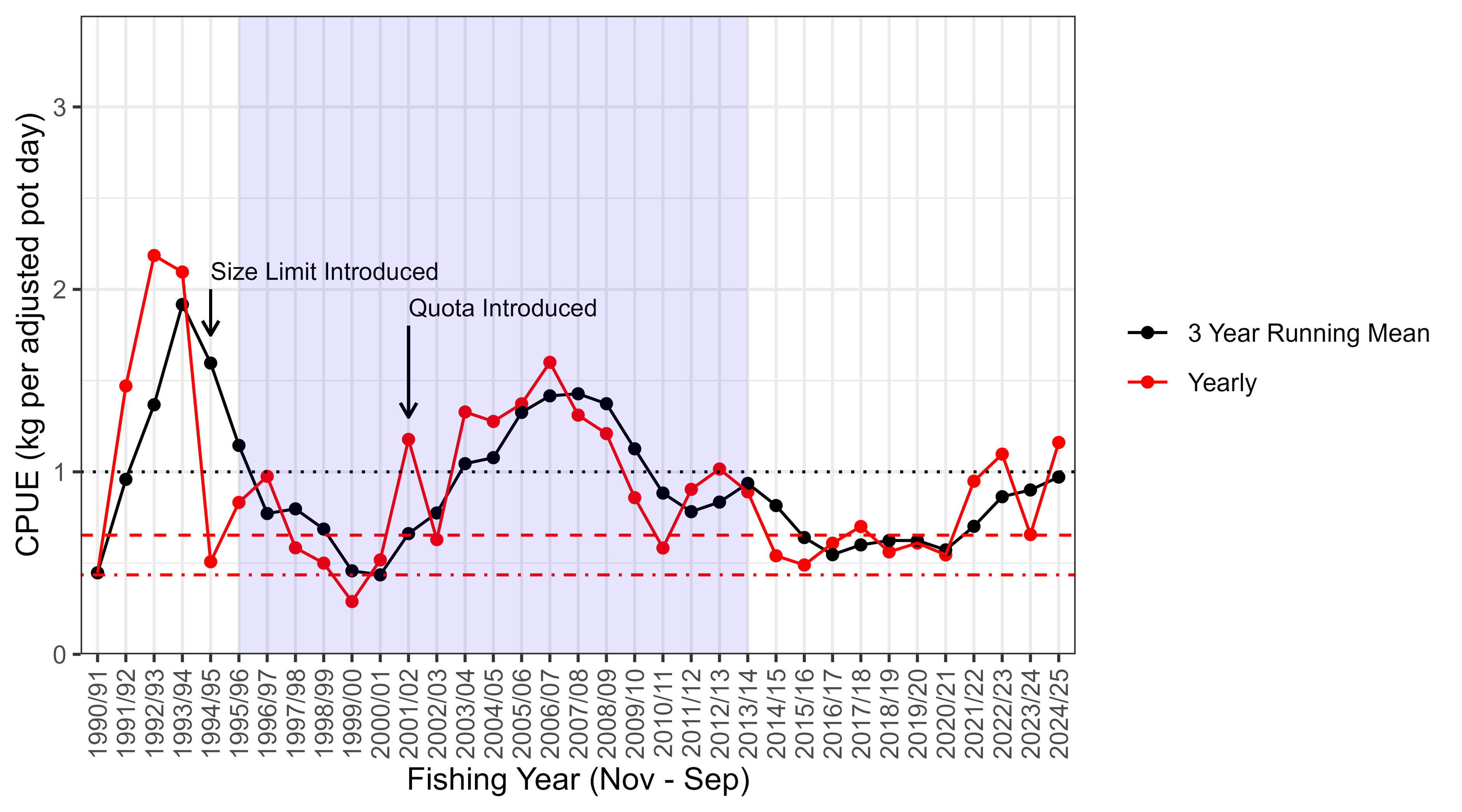
Figure 1: CPUE (kg per adjusted pot day). The current agreed time series is shown in red and the three-year running mean from the harvest strategy in black. The target, threshold and limit reference points are shown as horizontal lines from top to bottom. The shaded purple area is the reference period on which the reference points are based.
The annual TACC is set based on the application of the above rules and determination of the tier level outlined in the harvest strategy. Each level has rules that set the TACC, as per the following:
Level 1 is the baseline management arrangements for the Fishery and applies unless the requirements are met at another level.
- If CPUE exceeds the threshold reference point, the TACC remains unchanged.
- If CPUE falls below the threshold reference point, the TACC is reduced by up to 50%.
- If CPUE falls below the limit reference point, a stock rebuilding strategy is developed and the TACC is reduced by 50-100%.
- If the Fishery returns to Level 1 from a higher level and has an existing TACC greater the Level 1 cap of 10.5t, the TACC is automatically reduced to 10.5t.
Level 2 is applied if recent representative length frequency data is available in sufficient quantity, and can be verified, to provide insight into stock structure
- If CPUE falls below the threshold reference point, the TACC is reduced by up to 50%.
- If CPUE falls below the limit reference point, a stock rebuilding strategy is developed and the TACC is reduced by 50-100%.
- If the CPUE is above the target reference point, the TACC can be increased by 20%. A maximum increase of a total of 20% can be applied in any three-year period.
- Length-frequency data provides a secondary indicator. A TACC increase is conditional on satisfactory recruitment from this indicator.
Level 3 can be applied if representative length-frequency data is available for three or more years, and a suitable model-based stock assessment has been conducted. The TACC under this level will be set based on the stock assessment model.
Total Allowable Catch Forums
Total Allowable Commercial Catch Forums are held annually, usually in April, and are the principal means by which stakeholders are informed of the biological condition of the fishery and can comment on the evaluation of the status of the stock. The stock assessment provides an assessment of key performance indicators which are then assessed against the criteria in the decision framework to establish a total allowable catch for the following season.